
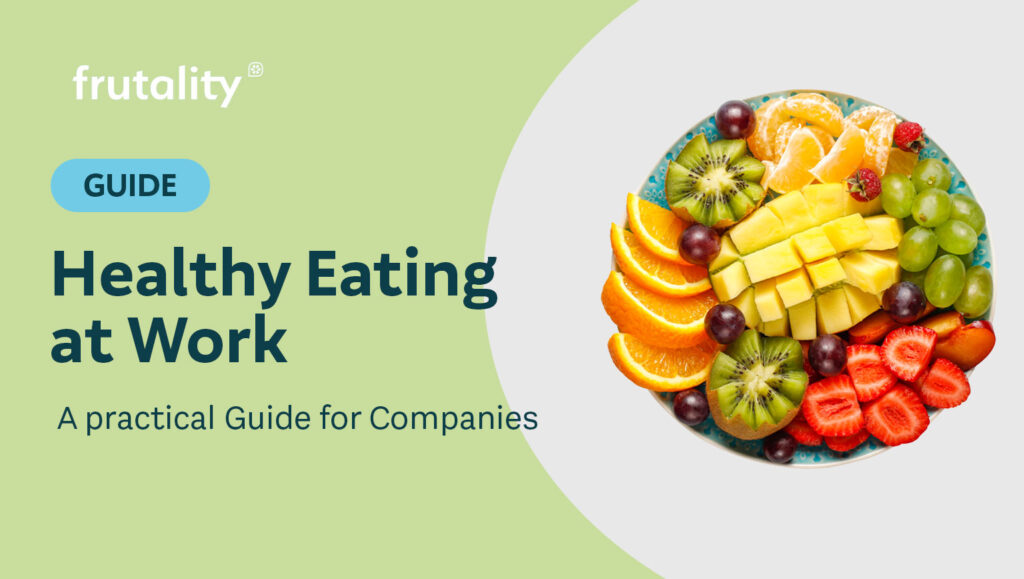
Healthy eating at work is the set of habits and decisions that help your team eat better during the workday: from what’s available in the office to the culture surrounding meals. Taking care of it isn’t a cosmetic detail—it directly affects people’s focus, energy, and well-being.
In this practical guide you’ll see why it matters, the most common mistakes in offices, and, above all, how to roll out a healthy-eating strategy at your company step by step, without big budgets.
In short
- Healthy eating at work improves focus, reduces fatigue, and contributes to a better workplace atmosphere.
- The main obstacles are unhealthy snacking, too much coffee, and the lack of accessible options in the office.
- Implementing it is a matter of environment and culture: keep healthy options within reach, communicate it, and measure its impact.
- Fresh fruit is the simplest and most affordable way to get started.
What is healthy eating at work?
We talk about healthy eating at work when the company makes it easy for its employees to maintain a balanced diet during the workday: nutritious options within reach, suitable spaces to eat, and a culture that doesn’t penalize self-care. It’s not about imposing diets, but about making the easy option also the healthy option.
The World Health Organization recommends eating at least 400 grams of fruits and vegetables a day, the equivalent of about five servings. A good part of that intake happens, or should happen, during the hours we spend working.
Why does it matter for your company?
Taking care of your team’s nutrition delivers a tangible return for the organization, not just for the individual:
- More focus and energy. A balanced diet helps keep energy levels stable and prevents the mid-morning or afternoon slumps.
- Less absenteeism. Healthier habits are associated with better overall health. We dig into this in our guide on how to reduce workplace absenteeism.
- Better atmosphere and talent retention. Small gestures of care strengthen the sense of belonging and the team’s commitment.
- The image of a company that cares. Well-being is now an employer-branding asset in the eyes of candidates and clients.
If you want to dig deeper into the link between nutrition and performance, you’ll find our article on how to boost your team’s productivity in the office helpful.
Common eating mistakes in the office
Before building good habits, it’s worth identifying the ones that drag you down. These are the most frequent:
- Unhealthy snacking: cookies, pastries, and salty snacks on hand when fatigue or stress sets in.
- Too much coffee: useful in moderation, but overdoing it causes jitters and energy swings.
- Skipping meals or eating quickly in front of the screen, without a real break.
- Lack of healthy alternatives: if the only thing within reach is the vending machine, the less healthy option will win.
- Poor hydration: a point we tend to overlook that fully affects performance. We cover it in detail in hydration in the office and summer fruit.
How to implement healthy eating at your company, step by step
You don’t need a big program to get started. Here’s a simple, realistic roadmap:
1. Run a quick assessment
Observe what people eat in the office today and ask your team. A short survey about habits and preferences will give you a starting point and, along the way, make people feel heard.
2. Improve the environment (the most effective step)
People eat what’s within reach. Make the healthy choice easy: accessible fresh fruit, water available at all times, and healthy options in the break area. Changing the environment is more effective than asking for willpower.
3. Communicate and educate
Pair the changes with light internal communication: reminders, snack ideas, small health tips. The goal is to inform without lecturing.
4. Nurture the culture and lead by example
Make self-care something that’s looked upon favorably. Respecting meal breaks and having leadership set the example is worth more than any poster.
5. Measure and adjust
Review what works every so often: fruit consumption, participation, team feedback. Adjust based on what you see, not on what you assume.
The role of fresh fruit in the office
If we had to pick a single first step, it would be this: fresh fruit available to the team. It’s accessible, requires no preparation, covers part of the recommended five daily servings, and is a natural alternative to snacking. On top of that, in summer it provides hydration, a key factor we explore in our article on summer fruit and performance.
Healthy snacks vs. options to avoid
| Instead of… | Offer… | Why |
|---|---|---|
| Pastries and cookies | Fresh seasonal fruit | Sustained energy without sugar spikes |
| Salty vending-machine snacks | Plain nuts | Filling and with healthy fats |
| Sugary sodas | Water and water-rich fruit | Hydrating without added sugars |
| A fourth or fifth coffee | Herbal teas or a piece of fruit | Avoids jitters and energy swings |
Frequently asked questions
Where should a company that wants to take care of its team’s nutrition start?
With the environment. The most effective and affordable step is to keep healthy options within reach, starting with accessible fresh fruit and water available throughout the day.
How much fruit should an office offer?
As a reference, the WHO recommends at least 400 g of fruit and vegetables per person per day. In the office, it’s enough to ensure at least one piece available per employee per day and adjust based on actual consumption.
Does healthy eating at work affect productivity?
Yes. A balanced diet and good hydration help maintain focus and prevent energy slumps, which translates into better performance throughout the day.
Is it expensive to implement these habits?
Not necessarily. Many measures (improving the environment, communicating, looking after breaks) cost very little, and services like office fruit delivery adapt to the size and budget of each company.
Want to bring healthy eating to your office?
At Frutality we deliver fresh seasonal fruit to your company, with no lock-in and paying only for what you consume.