
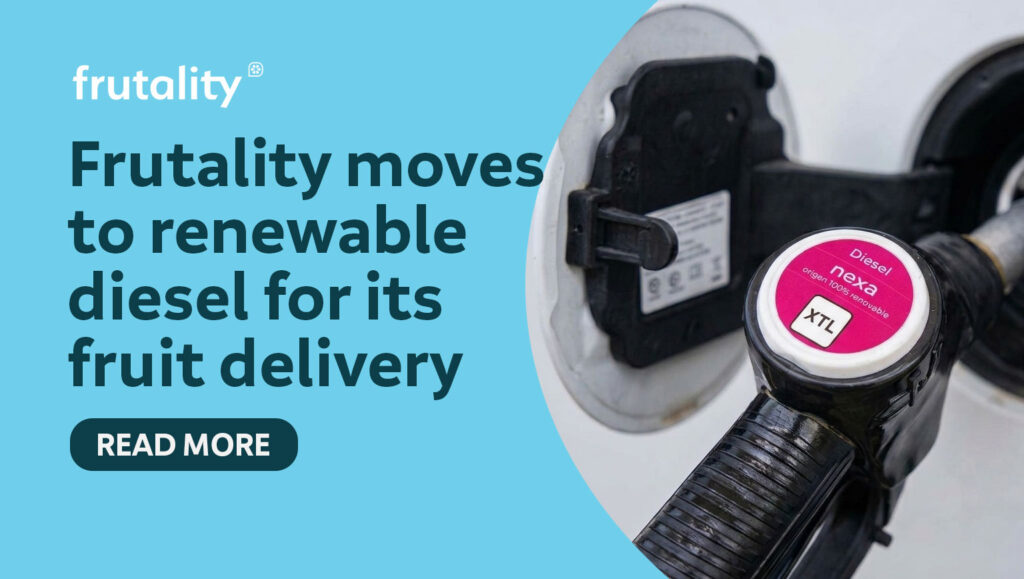
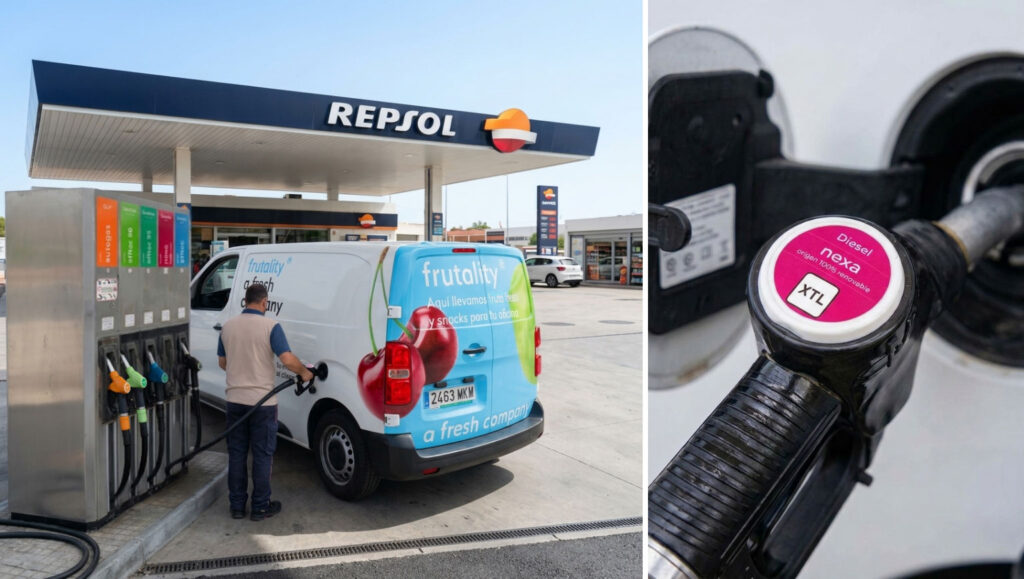
Frutality has started fueling its delivery vans with Repsol’s Diesel Nexa, a 100% renewable fuel. It is a renewable diesel that can cut up to 90% of net CO₂ emissions per liter of fuel replaced over its life cycle, compared with mineral diesel. It is a new step in reducing the company’s carbon footprint, which since January 2026 holds the ISO 14064-1 certification, focused precisely on cutting its emissions.
In this article we explain what this step means, what renewable diesel is, and why it matters to the HR and procurement teams that manage corporate wellbeing suppliers.
In short
- Frutality fuels with Repsol’s Diesel Nexa, a renewable diesel of 100% non-fossil origin.
- It can cut up to 90% of net CO₂ emissions per liter of fuel replaced, over its life cycle.
- The change builds on its ISO 14064-1 certification, obtained in January 2026 and focused on reducing its carbon footprint.
- Service and pricing are not affected.
- It helps HR and procurement with sustainability reporting by reducing scope 3 emissions.
What has changed in Frutality’s delivery?
Since November 1, 2026, Frutality’s vans have started fueling with Repsol’s Diesel Nexa instead of conventional diesel. It is a 100% renewable fuel that can cut up to 90% of net CO₂ emissions per liter replaced over its life cycle, compared with mineral diesel. It is one more step within a sustainability strategy that already holds the ISO 14064-1 certification since January 2026, focused on reducing the company’s carbon footprint.
At Frutality we care not only about which fruit and snacks we bring to each company, but also about the impact our activity has on the community and the planet. Delivery is the part that weighs most on our carbon footprint, which is why we have taken this step: a real, measurable change that also helps our clients reach their sustainability goals. For whoever receives the office fruit delivery, the experience does not change: the same fresh fruit for offices service, with no impact on service or pricing, but with a far smaller transport footprint.
What is renewable diesel (HVO) and why does it cut emissions?
Diesel Nexa is an HVO renewable diesel (hydrotreated vegetable oil), made from residual feedstocks instead of petroleum. Here are its keys.
What it is made of
It is produced from waste such as used cooking oil or agri-food residues, giving them a second life instead of relying on a fossil source.
Why it cuts net emissions
Because it does not come from a fossil source, its combustion does not add new carbon to the atmosphere, which explains the strong reduction in net emissions over its life cycle. You can read more about renewable fuels in the European Commission’s work on the EU framework for biofuels.
Compatibility
It is compatible with current diesel engines with no modification needed, which allows the switch to happen immediately across the existing fleet.
Why this change matters to HR and procurement
The transport of orders is part of the indirect (scope 3) emissions of any company’s supply chain. For the HR and procurement teams that manage corporate wellbeing suppliers, working with a supplier that measurably reduces its delivery footprint makes sustainability reporting easier and strengthens the organization’s own ESG commitment, without affecting service or pricing.
Scope 3 is usually the largest and hardest-to-cut part of a company’s footprint, as the international reference standard, the GHG Protocol Scope 3 Standard, sets out. Transport is a major source across Europe, as the European Environment Agency documents. Choosing fruit suppliers that measure and reduce their footprint is a concrete lever to move those goals forward.
Our impact in numbers
The move to renewable diesel builds on facts that have been part of Frutality’s day to day for years.
| Indicator | Figure |
|---|---|
| Fuel emissions | Up to 90% less net CO₂ per liter replaced |
| Fruit saved (2025) | More than 40,000 kg of fresh fruit |
| CO₂ saved (2025) | More than 50 metric tons |
| Savings for clients (2025) | More than 115,000 euros by matching real consumption |
| Waste ratio | 1.2% versus the 10% sector average |
Beyond the fuel: sustainability in facts
Renewable diesel is one more step within a way of working that Frutality backs with real actions:
- ISO 14064-1 certification, obtained in January 2026 and focused on reducing its carbon footprint, with continuous yearly work to progressively cut its emissions, in line with the international ISO 14064-1 standard.
- A waste ratio of 1.2% versus the 10% sector average, as part of its zero-waste approach.
- Work with local farmers under a fair-price, seasonal-fruit policy.
- Recognition as a Sustainable Supplier by the UN Global Compact.
- Certification as a B Corp, which verifies its positive impact across all its stakeholders. You can learn more on our certifications and sustainability page.
Frequently asked questions
How much does Frutality’s renewable diesel cut emissions?
Repsol’s Diesel Nexa, which Frutality fuels with, can cut up to 90% of net CO₂ emissions per liter of fuel replaced over its life cycle, compared with mineral diesel.
What is Diesel Nexa and what is it made of?
It is an HVO renewable diesel (hydrotreated vegetable oil) made from waste such as used cooking oil or agri-food residues, instead of petroleum. It is compatible with current diesel engines with no modifications.
Does the service or price change with renewable diesel?
No. It is the same office fruit service and the same pricing. The only thing that changes is the fuel in the tank, with a far smaller transport footprint.
Why does this help my company’s sustainability goals?
Because the transport of orders is part of your scope 3 emissions. A supplier that measurably reduces its delivery footprint makes your sustainability reporting easier and strengthens your ESG commitment.
Fruit that cares for your team and the planet too
At Frutality we bring fresh fruit for offices in Barcelona and across Spain, with a simple, no-lock-in office fruit service and an increasingly sustainable delivery. Tell us what your team needs and we will put together a proposal.